What Makes Up 95% of the Universe That We Cannot See?
March 30, 2026 · 4 min read
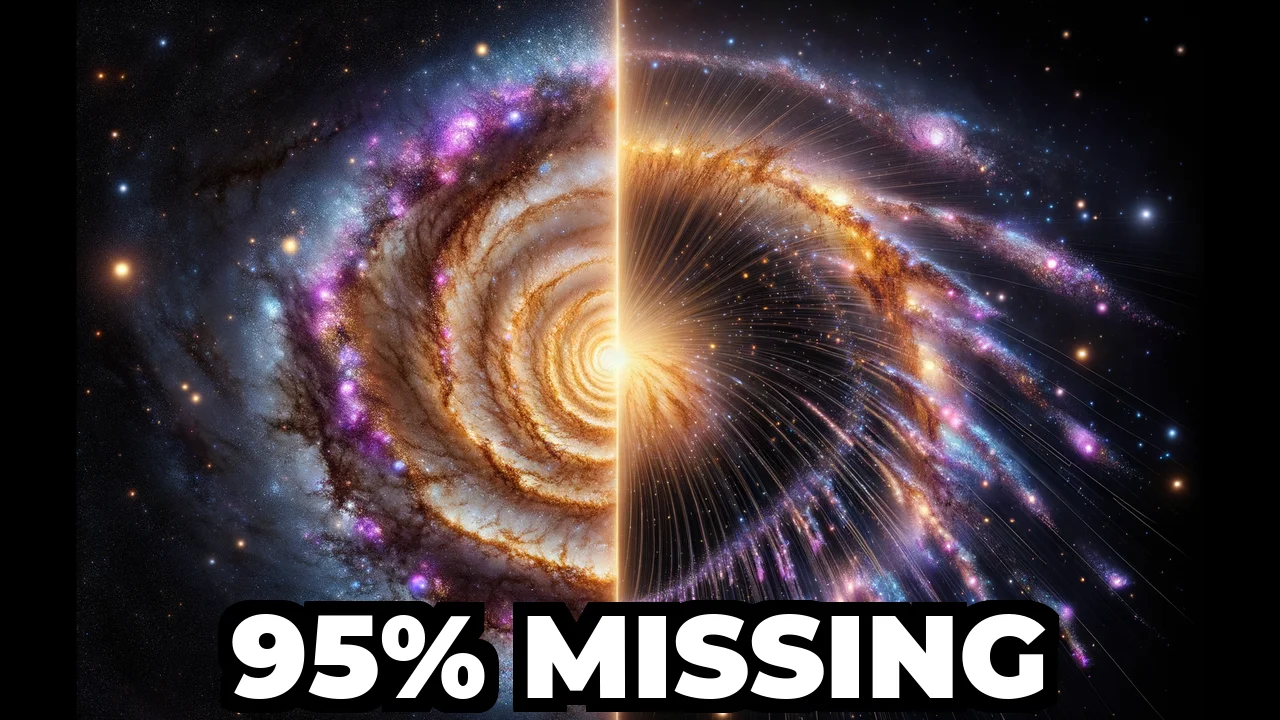
Dark matter and dark energy comprise approximately 95% of the universe, with dark matter making up about 27% and dark energy accounting for roughly 68% of all cosmic content. These invisible components fundamentally shape the structure and fate of our cosmos, yet remain among the greatest mysteries in modern science.
The Discovery of Dark Matter
The story begins in 1933 when Swiss astronomer Fritz Zwicky observed the Coma galaxy cluster and noticed something impossible. The galaxies were moving so rapidly that they should have escaped the cluster’s gravitational pull long ago. Zwicky calculated that some invisible mass—about 400 times more than what could be observed—was holding the cluster together. He called this mysterious substance “dunkle Materie” or dark matter.
For decades, the scientific community largely ignored Zwicky’s findings. That changed in the 1970s when American astronomer Vera Rubin conducted groundbreaking observations of spiral galaxies. She discovered that stars at the outer edges of galaxies orbited at nearly the same speed as those near the center—a phenomenon that defied the laws of physics as understood at the time. According to Newtonian mechanics, outer stars should move much slower, like planets in our solar system where Neptune orbits far more slowly than Mercury.
Understanding Dark Matter’s Properties
Dark matter exhibits extraordinary properties that make it fundamentally different from ordinary matter. It doesn’t emit, absorb, or reflect electromagnetic radiation of any kind—no visible light, radio waves, X-rays, or gamma rays. This invisibility means we can only detect dark matter through its gravitational effects on visible matter and light.
Scientists have mapped dark matter’s distribution throughout the universe using gravitational lensing, a phenomenon where dark matter’s gravity bends light from distant galaxies. These maps reveal a cosmic web—vast filaments of dark matter stretching across space, forming the scaffolding upon which galaxies and galaxy clusters are built.
The leading theoretical candidate for dark matter is the WIMP (Weakly Interacting Massive Particle). Despite billions of dollars invested in detection experiments, including sophisticated detectors buried deep underground to eliminate interference, scientists have yet to directly observe a single dark matter particle.
The Shocking Discovery of Dark Energy
In 1998, two independent research teams studying distant supernovae made a discovery that fundamentally changed our understanding of the universe. They expected to find evidence that the universe’s expansion was gradually slowing due to gravity. Instead, they discovered the opposite—the universe’s expansion was accelerating.
This acceleration pointed to the existence of dark energy, a mysterious force that appears to be built into the fabric of space itself. Unlike dark matter, which clumps together and behaves somewhat like ordinary matter, dark energy exhibits repulsive properties that push space apart.
Dark Energy and the Universe’s Fate
Dark energy’s dominance—comprising about 68% of the universe—has profound implications for cosmic evolution. As the universe expands, dark energy doesn’t dilute like ordinary matter. Instead, it maintains constant density, meaning the total amount of dark energy increases as space grows, causing expansion to accelerate exponentially.
This leads to several possible scenarios for the universe’s ultimate fate. The “Big Rip” theory suggests dark energy could eventually become so powerful that it tears apart galaxies, solar systems, planets, and even atoms themselves. Alternatively, the “Big Freeze” scenario envisions continued expansion until all stars burn out and the universe reaches maximum entropy. A third possibility, the “Big Crunch,” would occur if dark energy somehow reverses, causing everything to collapse back into a single point.
Recent Discoveries and Implications
The James Webb Space Telescope has recently identified ancient galaxies that formed just 500 million years after the Big Bang—far earlier and more massive than existing models predict. This discovery suggests dark matter may have behaved differently in the early universe, potentially requiring a complete revision of our cosmic timeline and challenging the standard model of cosmology.
Some physicists propose that dark matter and dark energy might be manifestations of a single phenomenon called “dark fluid”—a unified field that could explain both galactic structure and cosmic acceleration. While controversial, this theory offers an elegant solution to two of cosmology’s greatest puzzles.
The Humbling Reality
Perhaps the most profound aspect of dark matter and dark energy is what they reveal about the limits of human knowledge. Every scientific instrument ever built, every experiment ever conducted, and every particle ever studied represents just 5% of the universe’s total content. We are navigating the cosmos with an incomplete map, using physical laws derived from a tiny fraction of reality.
This invisible 95% doesn’t represent a failure of science but rather its greatest frontier. As detection methods improve and theoretical models evolve, we edge closer to understanding these cosmic mysteries that govern the very structure and destiny of everything we know.
FREQUENTLY ASKED
How do we know dark matter exists if we can't see it? ▾
Scientists detect dark matter through its gravitational effects on visible matter and light, such as galaxy rotation curves and gravitational lensing of distant galaxies.
What is the difference between dark matter and dark energy? ▾
Dark matter acts like invisible matter that clumps together and holds galaxies together, while dark energy is a repulsive force built into space itself that causes the universe's expansion to accelerate.
Could dark matter and dark energy be the same thing? ▾
Some scientists propose they might be different aspects of a unified "dark fluid," but this remains highly theoretical and controversial in the scientific community.